Hydra-Tack Ultra: What It Is and Why It Outperforms Standard Tackifiers
Anyone who has watched a hydroseeded slope wash out after a single hard rain knows the frustration: the seed was good, the mulch was applied correctly, but the tackifier holding it all together simply couldn't keep up with the site conditions. On steep grades, poor soils, or in high-rainfall regions, a standard tackifier is often the weak link in an otherwise solid erosion control plan.
What Hydra-Tack Ultra Is and Why It Bonds Differently
Most tackifiers rely on a single bonding mechanism to hold mulch and seed to the soil surface. Hydra-Tack Ultra uses a four-way active ingredient system: polyacrylamides, micro-emulsified polymers, a soil surfactant, and a highly concentrated blue dye, each doing a distinct job.
On the surface, the micro-emulsified polymers act as a latex-based "sticker" that adheres immediately and effectively to the applied area, reinforcing the tacking and dust-control performance of the mulch layer.
In the soil, the polyacrylamides (PAM) function as anionic, super-absorbent polymers that retain large quantities of water and nutrients. Unlike many PAM compounds that simply hold onto moisture once hydrated, these are formulated to release water and nutrients back to the seed consistently over time, supporting germination rather than just locking moisture away.
For water management, a 30-day soil surfactant ensures adequate moisture stays present in the soil during the critical germination window, using multi-polymer technology for stabilization.
The combined result is a remarkable fiber-to-soil bond that reduces erosion and water runoff and significantly enhances dust control. The product is also rated rain-fast in 30 minutes, offering peace of mind during applications.

Hydroseeding application in progress on a bank of bare soil.
Application Rates & Use Cases
Per the manufacturer, Hydra-Tack's application rates are as follows:
Modest to 4H:1V Slope: 2.5 gallons per acre
>3H:1V Slope: 5 gallons per acre
Dust Control: 11 to 22 oz. per 100 gallons H2O (2.5 gal. to 5.0 gal. per 3,000 gal. H2O)
The pattern here is straightforward: the steeper the slope, the higher the application rate, because that's precisely where a standard tackifier is most likely to fail. Cut and fill slopes, DOT right-of-way grading, and similar high-gradient sites are where wash-off during a storm event can undo days of work in minutes.
The soil surfactant component also makes this product a stronger fit for poor or marginal soils where moisture retention during germination is the limiting factor, not just erosion. And in high-rainfall regions, the 30-minute rain-fast window offers a big advantage.
For a flat, well-vegetated site with average rainfall, a standard tackifier will likely do the job, but when slope, soil quality, or rainfall risk stack the odds against a standard product holding: Hydra-Tack Ultra can give you the edge you need.
What to Expect on Install Day
A few practical notes for contractors planning an application:
1. Confirm slope classification before mixing. Application rates are tied directly to slope grade, so knowing your site's steepest section ahead of time determines your gallons-per-acre going in.
2. Watch the blue dye. The highly concentrated blue colorant shows exactly where the Hydra-Tack has and hasn't been applied, helping crews avoid skips and overlaps (and avoid wasting product).
3. Mind the clock after application. Hydra-Tack Ultra is rated rain-fast in 30 minutes, so timing the application with an eye on incoming weather gives the product the best chance to set up properly.
4. Confirm mixing order and rates against the current label or SDS before application, since tank-mix sequencing and exact rates can vary by equipment and site conditions. Your HydraSmart supplier can walk through this for a specific job.
Where to Get It
HydraSmart products, including Hydra-Tack Ultra, are available through a network of regional partners, including Environmental Construction Solutions. If you're planning a project on a slope where standard tackifiers have let you down before, it may be worth a conversation about whether this is the right fit for your site. Reach out to us here.
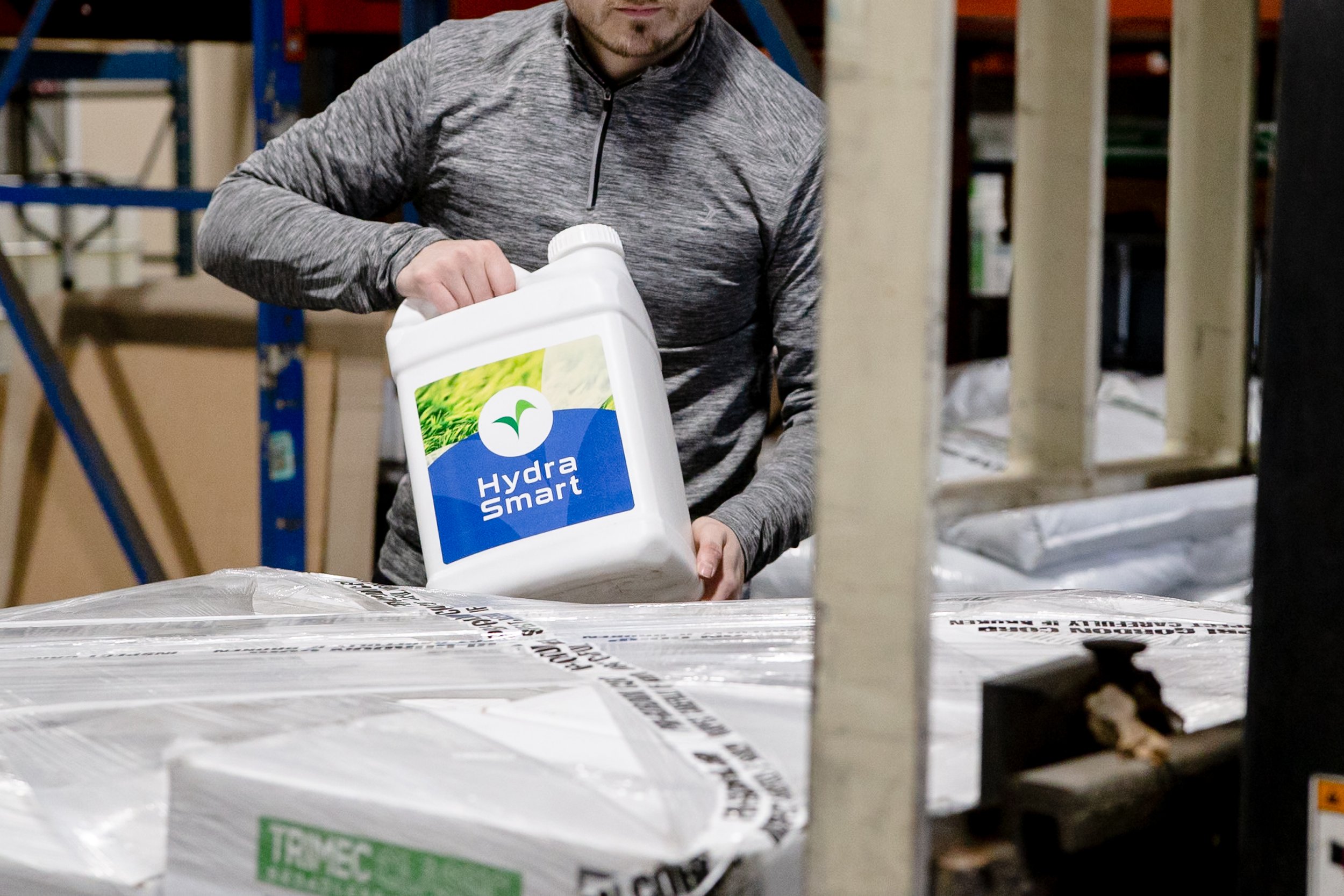
Warehouse associate picking a jug of HydraSmart.