Understanding TDOT Specifications for Rolled Erosion Control Products
Tennessee's terrain covers a lot of ground, literally. Mississippi River floodplains in the west, loess hills and red clay through Middle Tennessee, karst limestone on the Highland Rim, and steep benches on the Cumberland Plateau in the east. That range of soil types, slope conditions, and rainfall patterns is exactly why the Tennessee Department of Transportation (TDOT) doesn't treat rolled erosion control products (RECPs) as one-size-fits-all. TDOT classifies and specifies these products by tested performance and site conditions, and contractors who understand that system can avoid submittal delays, rejected material, and field problems down the line.
This post walks through how TDOT's classification system works, where the governing documents live, and what to check before ordering material for a project.

Rolled erosion control products being unloaded on a job site.
Where TDOT's RECP Requirements Live
Three documents do most of the work here, and knowing which one governs which question saves a lot of back-and-forth on a project:
TDOT Standard Specification 918.28
This is the material spec, referenced directly in TDOT's own Drainage Manual as the source for blanket-type requirements.TDOT's Qualified Products List (QPL 17), Section B
This covers Rolled Erosion Control Products specifically. This is the actual list of pre-approved products. Nothing gets used on a TDOT project unless it's listed here or separately approved.TDOT's Design Division Drainage Manual, Chapter 10, Section 10.08.1.12.4
This is the design-side guidance. It governs when an ECB is required at all, and which type applies to a given slope.
Material qualification lives in the QPL. Design and type selection live in the Drainage Manual. Both matter, and they answer different questions.
How TDOT Classifies and Qualifies RECPs
Before a product can appear on TDOT's Qualified Products List, it has to go through the National Transportation Product Evaluation Program (NTPEP), a shared, multi-state testing framework rather than a TDOT-only test. Products are evaluated or submitted for NTPEP evaluation as part of the qualification process.
Once qualified, TDOT assigns each product a type designation tied to a C Factor, the ratio of soil loss on a protected slope compared to an unprotected one. These values are supplied by manufacturers based on field testing under varied conditions. TDOT's system maps directly onto the Erosion Control Technology Council (ECTC) classification:
Type 1: ECTC Type: 2c, C Factor: ≤0.15 @ 3:1
Type 2: ECTC Type: 2d, C Factor: ≤0.14 @ 3:1
Type 3: ECTC Type: 3b, C Factor: ≤0.14 @ 3:1
Type 4: ECTC Type: 4, C Factor: ≤0.11 @ 3:1
Lower C Factor means better performance, less soil loss relative to a bare slope under test conditions, which is why Type IV is reserved for the most demanding applications.
It's worth noting that TDOT's Types 1 through 4 are all temporary erosion control blankets (ECBs). Turf reinforcement mats (TRMs) are a separate product category intended for permanent, longer-term reinforcement, and they come into play in specific channel and slope conditions discussed below.
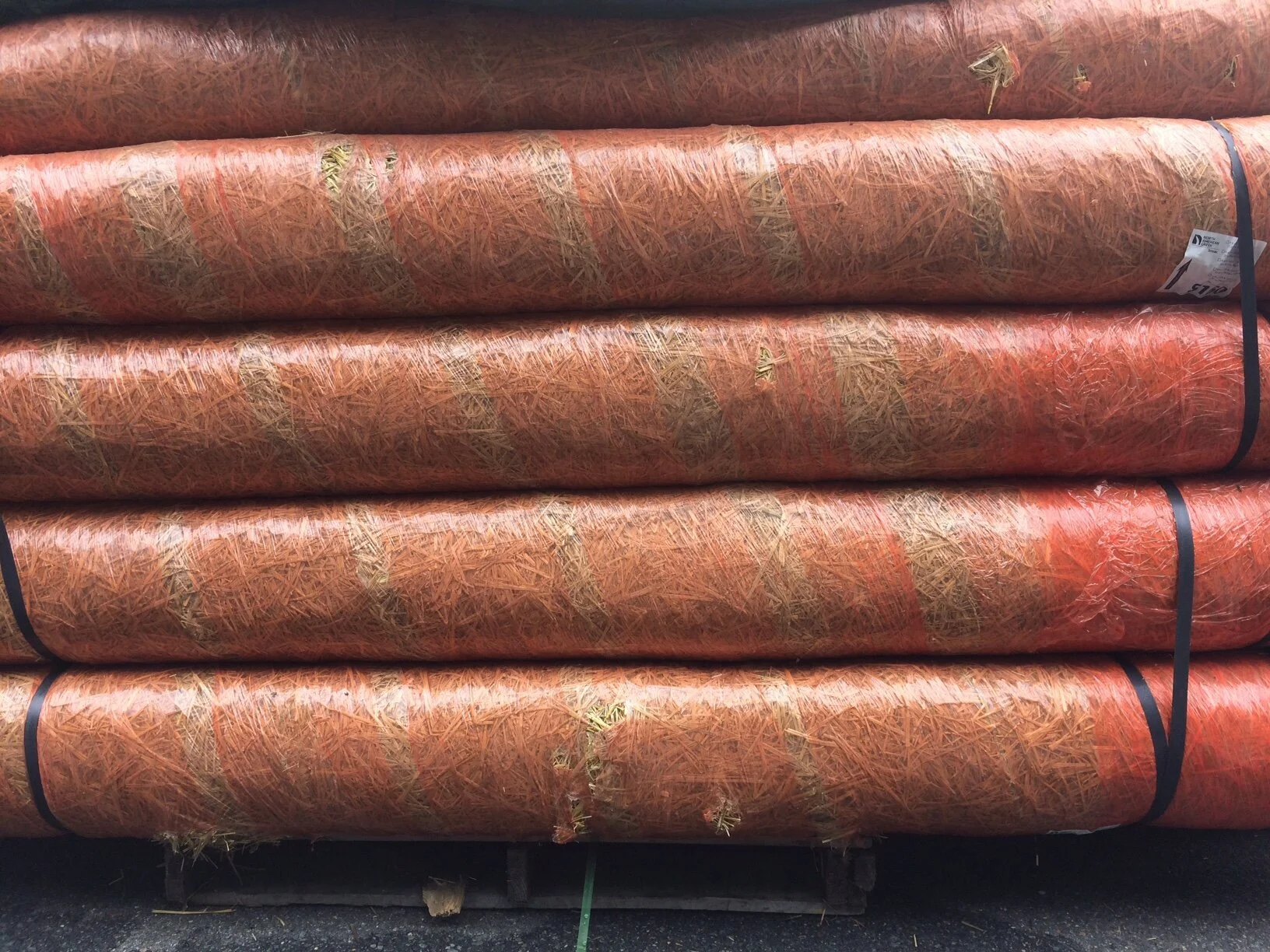
Rolled erosion control products stacked inside of a warehouse.
When and Where TDOT Specifies Each Blanket Type
TDOT's Drainage Manual lays out clear criteria for which type applies to which slope:
Type 1: continuous slopes 3H:1V or flatter, up to 20 feet in height
Type 2: continuous slopes 3H:1V or flatter over 20 feet, or continuous 2H:1V slopes up to 80 feet
Type 3: continuous 2H:1V slopes over 80 feet
Type IV: only when specified by TDOT's Soils and Geology Section
The manual also lays out terrain-based triggers for when an ECB is called for in the first place, including flat or rolling terrain with 2H:1V or 3H:1V slopes 20 feet or greater in height, and mountainous or hilly terrain with those same slope ratios at 30 feet or greater. Beyond slope and terrain, TDOT also calls for ECBs on highly erodible soils such as sandy soils in West Tennessee, on urban or residential slopes where sod isn't specified, near Exceptional Tennessee Waters, on bridge and abutment protection, and at locations where installing silt fence or filter socks would be impractical.
Channel and ditch applications add another layer.
For permanent seeding in a vegetated channel, TDOT requires the shear stress at design flow to be 2.0 lb/ft² or less before an ECB can be used at all. Above that threshold, a turf reinforcement mat is required instead of a blanket.
For temporary seeding, the type is selected based on the shear stress from the 2-year peak discharge under unvegetated conditions, or the 5-year event for sites draining to Exceptional Tennessee Waters.
The practical takeaway: being on the QPL doesn't automatically mean a product is the right type for a given slope. The project plans specify the required type, and that's what to check against slope height, grade, and the current QPL listing.
What Contractors Should Check Before Ordering Material
Confirm the exact TDOT Type (1 through 4) called out in the project's plans, not just "erosion control blanket" generically.
Cross-check the specified product against the current QPL 17, Section B listing, since these lists get revised and products can be added or removed.
For channel or ditch applications, confirm whether the design calls for permanent or temporary seeding. That determines whether a blanket is even permitted or a TRM is required.
Verify slope height and grade against the Drainage Manual's type-selection criteria before assuming a lower-cost Type I or II will meet spec on a taller or steeper cut or fill slope.
The Bottom Line
TDOT's RECP system is ultimately about matching tested C Factor performance to real slope, soil, and channel conditions across a state with a lot of geographic range. Getting the type match right at the start of a project avoids rejected material and field problems later.
If you're working through TDOT specs on an upcoming project, ECS's RECP product line maps to TDOT's Type I through IV system, and our team can help match your project's spec requirements to the right product before you order. To discuss your project further: reach out to us here.
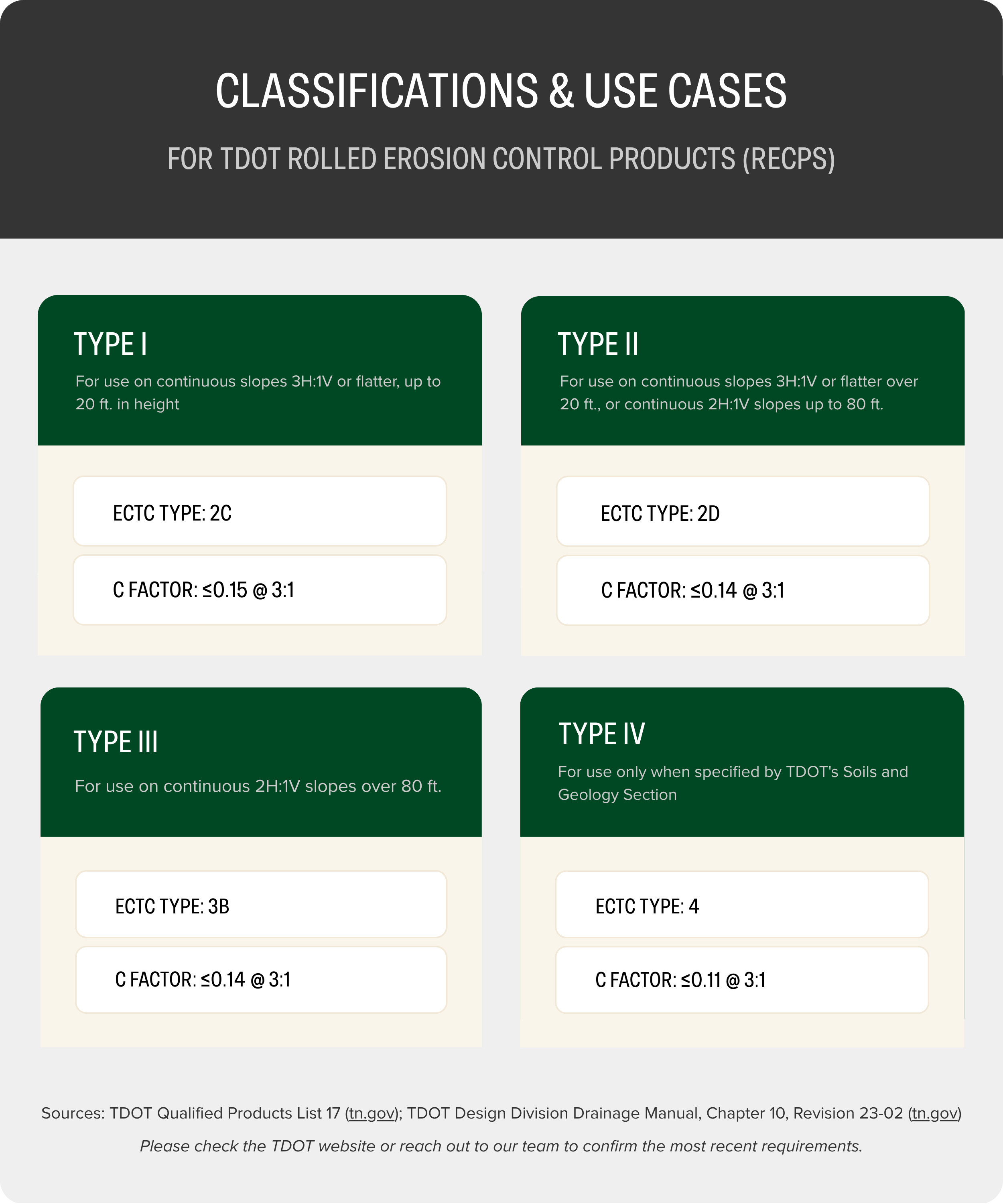
Graphic summarizing Tennessee Department of Transportation Classifications & Use Cases for Rolled Erosion Control Products (RECPs), including ECTC Types and C Factors.